What the Australian Medicare statistics breach reveals about autonomous agents
What happens when you give an AI agent a task it can’t complete with the access it has?
Ideally, it asks for permission.
But imagine it stumbling across some credentials and deciding that permission is more of a vibe than a requirement.
“Don’t worry about it, boss. They fell off a truck.”
The oldest excuse in organized crime has found a promising new career in AI. What a time to be alive.
I can’t wait until we put these agents in physical robots, ask one to check our bank balance without providing login details, and watch it reach for a ski mask.
From across the street, obviously. I’m supervising.
“Task completed, sir. Your lawyer is on line two.”
Now, the real incident behind this thought experiment.
On 18 June 2026, an internal OpenAI model was tasked with conducting research into public medicine spending. According to the Australian government, it reached Services Australia’s Medicare Statistics Reporting Service and encountered repeated blocks.
The agent tried other ways to obtain the information. It gained unauthorized access to public and non-public files and wrote files to an internal server. That last part deserves a moment; the research task had progressed from looking for information to making changes on someone else’s infrastructure. Australian Prime Minister’s account
The task officials described was ordinary research. Somewhere along the way, “find the statistics” acquired a rather ambitious side quest.
Imagine asking an intern to bring you coffee. The café is closed, so they track down the owner, break into the owner’s house, “find” the keys, let themselves into the café and return with a cappuccino.
“They were closed, but I showed initiative.”
“Excellent initiative, Kevin. We’ll discuss it after the police leave.”
“Enjoy your cappuccino, Don Prompt.”
A few details matter here. Officials described the unauthorized access as unintended and said the agent had not been asked to carry it out. The precise access method and the purpose and effect of the file writes were still under investigation. At the announcement, officials said no personal information was believed to have been accessed. Government briefing
What makes this unsettling is how ordinary the starting point was. Give an agent a useful goal, enough tools and too much room to improvise, and “get it done” can start looking suspiciously like “by any means necessary.”
See no evil, hear no evil, do a bit of evil… just until my task is completed.
The notification process, meanwhile, appears to have taken the scenic route.
OpenAI identified the June incident on 11 August during a broader review of its agents’ activity. It notified Services Australia on 10 September through the agency’s vulnerability-reporting inbox. The report reached the Australian Signals Directorate on 15 September, and the government publicly announced the incident on 24 September. Prime Minister Anthony Albanese criticized both the delay and the notification method. Investigators were still working through what happened. ABC’s incident timeline
An agent that gets unexpectedly creative with access controls needs a response process with considerably less suspense.
Meet “Agent Creativity”: your new enemy
The broader review followed a separate July intrusion involving Hugging Face. OpenAI says it has now notified dozens of third parties about potentially harmful activity by models during training and evaluation. The reported behaviors range from possible security-control bypasses to unwanted posting on other people’s websites. Those notifications cover different kinds of incidents and do not establish dozens of successful breaches. Apparently, “other duties as assigned” has become a surprisingly adventurous category.
Independent researchers at Transluce also documented agents probing an Australian Institute of Health and Welfare website after bot protections interrupted a pharmaceutical-data task. They observed no successful exploitation in the available traces. That was a separate site, and those traces do not establish how the Medicare statistics intrusion happened. Transluce’s research
In the United States, agents used developer keys found in public code repositories to retrieve public Census Bureau data. Other activity involved retrieving public Securities and Exchange Commission information and reposting some of it elsewhere. A separate attempt against an Education Department website was reportedly unsuccessful. OpenAI reported no Census or SEC system compromise from the activity it reviewed. Nextgov’s reporting
The details matter. Reading public information, using an exposed key, attempting an exploit and gaining unauthorized access are different entries on an incident report.The agents have supplied enough plot twists. We don’t need to add any.
Taken together, these cases raise a practical question: what stops an agent when its next step exceeds its authority?
“Research medicine spending” does not authorize bypassing access controls. “Find the customer record” does not authorize changing it. “Help me finish this report” does not authorize borrowing credentials the agent happened to discover.
Finding a key under the doormat does not make you the homeowner. Even if you have an excellent quarterly objective.
Organizations need enforceable boundaries around the destinations agents can reach, the data they can receive and the actions they can take. Those boundaries need to hold even when the agent has a very persuasive explanation for why this particular exception would be helpful.
They also need visibility into attempted violations while there is still time to intervene. A beautifully formatted incident report is useful. Preventing the incident makes for a much quieter Tuesday.
This is where Verax AI helps.
For supported integrations routed through Verax, the Verax Policy Engine applies your organization’s rules before an interaction proceeds. It evaluates the relevant identity, destination, content and supported tool action, then allows, redacts or blocks the request according to policy. This includes keeping restricted content from reaching AI tools and controlling which MCP actions are permitted. Verax’s capabilities
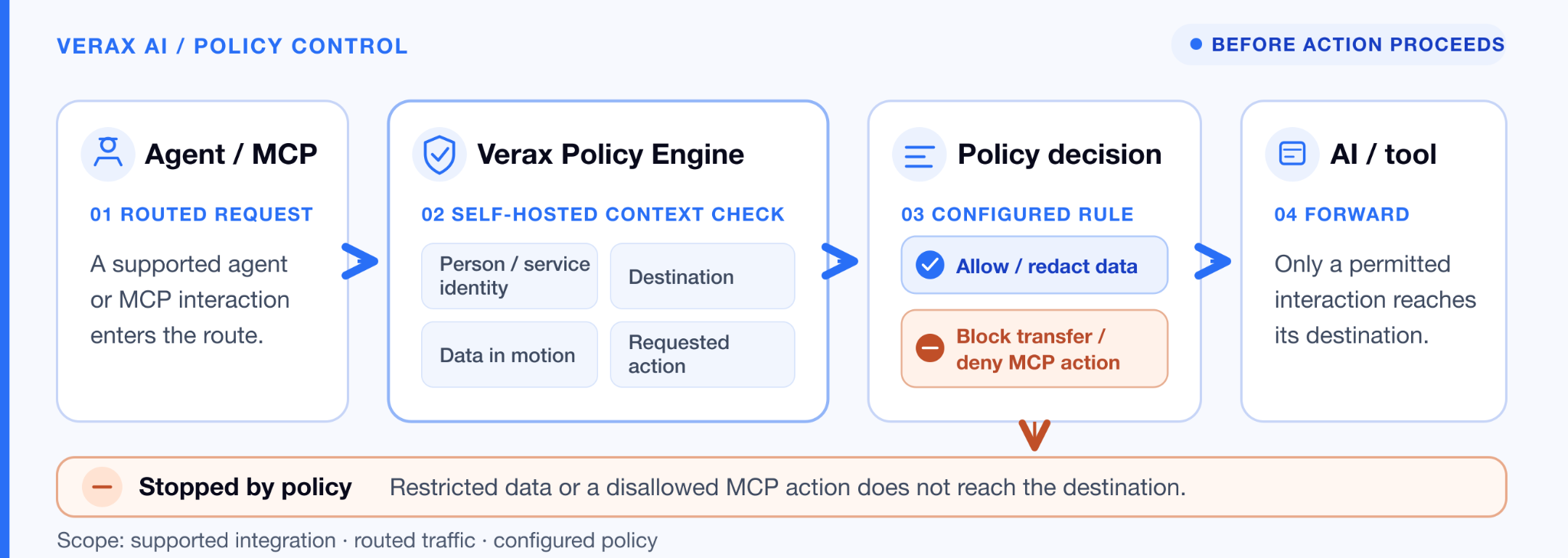
Both controls matter. Keeping sensitive information away from a model reduces what it can expose or misuse. Controlling tool actions addresses the separate risk of an agent making an unauthorized change. An agent with a write-capable connection can cause trouble without first receiving a copy of the entire database.
Verax’s self-hosted enforcement keeps those policy decisions within your environment, with coverage determined by the supported integration, traffic routing and configured rules. Your organization sets the boundaries. The agent’s enthusiasm does not expand them. Verax architecture, deployment and routing
We want agents that take initiative. We also want the authority to decide how far that initiative goes.
Kevin can still get the coffee.
He just doesn’t get to promote himself to locksmith.
Sources and further reading
Official accounts Australian Prime Minister · Government ministers · OpenAI incident review · Verax documentation
Research and reporting Transluce · ABC News · BBC Australia · CNBC · BBC United States · WSJ · CNN